
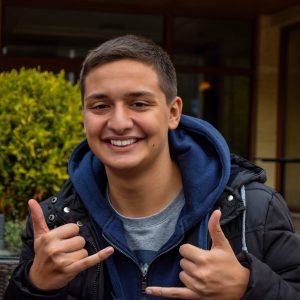
He’s only 24, and his whole being radiates one big smile. His biography is so impressive, you can’t help but wonder if he’s discovered a secret formula for stretching time.
This is Dimitar Ferdinandov – an aerospace engineer with a degree from the University of Birmingham and a Bulgarian Youth Delegate to the Council of the European Union.
Born and raised in Plovdiv, he comes from a family of teachers and openly credits his parents and grandparents as the ones who first sparked his curiosity and have always encouraged him to keep moving forward. He was just five or six years old when space captured his imagination.
Dimitar is one of the honorees of the joint initiative “The Excellent Students of Bulgaria”, organized by the Ministry of Education and the newspaper 24 Chasa. During his school years, he was a multiple-time laureate of the competition “Space – The Present and Future of Humankind” with original technical projects. He also became a semifinalist in the European Youth Space Contest Odyssey II. In 2018, he was invited by the U.S. Ambassador to join the delegation welcoming American astronaut Dr. Richard Linnehan at the ambassador’s residence.
He’s learned to focus on what truly matters to him. Deeply convinced that science should be made more accessible to everyone, Dimitar is a passionate science communicator. And how could he not be, having been inspired by shining examples like Carl Sagan, Neil deGrasse Tyson, and Brian Cox?
He keeps the child within him alive. Whenever he faces a difficult choice, he turns to that child – to the 10-year-old Mitko, whom he never wants to let down.
Dimitar Ferdinandov is also the co-founder of Datafrost Space – a company developing tools that simplify access to satellite data and services, particularly for users with no prior experience in the field. The startup was named the winner of the Slovak Space Office’s incubation program, recognised for having the best idea and fastest growth among fierce competition.
Remember this young man’s name. I’m certain we’ll be hearing it more in the years to come.

- Being an aerospace engineer sounds incredibly exciting—but also incredibly difficult. Tell us more about your education and your profession.
I have been fascinated by space since I was a child. During high school, I took part in both national and international competitions. I have never been a big fan of tests, so I leaned more toward project-based contests rather than Olympiads. I developed concepts for space elevators, large-scale asteroid defense programs, and even started producing science communication videos.
With the support of Ms. Kostadina Katsarova, my physics teacher at the Plovdiv Language School, I continued exploring my interest in satellite systems and infrastructure, which ultimately led me to pursue a degree in aerospace engineering.
I completed my Master’s degree at the University of Birmingham in the UK, surrounded by scientists and engineers who have worked on some of the most exciting European and American space missions. I served two terms as President of the University’s Space Society. Before stepping in as President, I led the rocketry team at the society, where we designed and built rocket models for national competitions in the UK. We even won an award for best design.
It is a demanding field, no doubt, but far from impossible, especially if you’re passionate about space. I emphasize this because I know many people who are fascinated by the cosmos or space travel who hold themselves back, thinking it is out of reach. The truth is, the space industry has room for everyone.
- Was this your childhood dream? How high do your dreams reach?
Absolutely. Since I was around five or six years old, I dreamed of working in space science and technology. Coming from a family of teachers, mathematicians, and engineers, I was especially encouraged by my grandparents to explore and ask questions.
We still retain my favorite childhood book collection at home “The Big Children’s Encyclopedia” from the “24 Chasa” newspaper. Although, to say we “retain” might be generous, as the eighth volume, dedicated to space, is so thoroughly read, it’s basically holding on by a thread.
At first, I leaned more toward astrophysics. But over time, I became increasingly fascinated by the technologies that allow us to study the stars and our place among them. That’s when I turned to engineering.
- How long is the journey from romantic, beautiful Plovdiv to the stars?
Infinitely short.
While the physical boundary between Earth’s atmosphere and space sits about 80–100 kilometers above us, space is already a vital part of our lives—whether through GPS navigation, which we rely on daily, or through the electric grid, which can be affected by geomagnetic storms. Space is not just “out there”; it’s part of our environment and something we need to understand.
In fact, we are the only known way the Universe has of exploring, understanding and appreciating itself.
Plovdiv, and especially the communities around Club Quant at the Technical University’s branch, played and continue to play a key role in building the foundation that helped me, and many other young scientists and engineers now scattered around the world, find our place in the space sector.
- You have a remarkably impressive résumé for someone your age. How do you manage to juggle so many things? How many hours are there in your day? How long is a second for you?
Honestly, I don’t always manage. But it gets easier with experience.
I’ve misprioritized. I’ve missed deadlines, some of which important. But I’ve never regretted focusing on the things that truly matter to me. That doesn’t always the things that are best for me or sometimes my future, but I learn my lessons, think what I can do better next time, and move on.
Lately, I’ve tried to limit how many things I juggle at once. As energizing as some projects and meetings may be, the late nights and lack of sleep catch up with you eventually. My advice to young people? There’s time for everything. Take it easy. Aylyak, as we say in Plovdiv.
As for youth policy, it’s something I find incredibly inspiring. Back in 2018, I initiated the creation of the National Student Parliament of Bulgaria. Today, as its coordinator, I’m proud that it continues to grow and thrive. It now connects 168 student councils and represents over 80,000 students, offering them a platform to voice their opinions on education.
Some of the most impactful ideas for improving school environments which I have heard in recent years – whether it’s fighting bullying or better exam preparation – have come from students themselves. I firmly believe our society loses out when it ignores young people and excludes them from decision-making. Not only do we alienate them, we miss out on bold, creative solutions.
As Bulgaria’s Youth Delegate to the Council of the EU for the past two years, I’ve seen that this isn’t just a local issue. Fortunately, across the EU, there’s a growing trend toward meaningful youth inclusion.
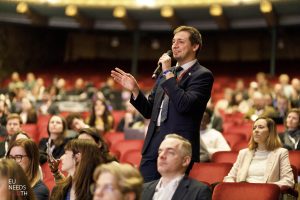
- How did your passion for science communication begin? Why is it worth doing—and how can we truly reach people’s hearts and minds?
It’s becoming harder, but also more important and urgent than ever before.
My own passion for physics, space science, and technology was sparked by science communicators like Carl Sagan, Neil deGrasse Tyson, and Brian Cox. On one hand, I hope to inspire someone else to discover their calling in space. On the other, I feel the space sector – especially in Europe – has been significantly overlooked over the last decade. Partly because the public doesn’t always understand how essential it is to modern life.
That’s why I created my blog Space Brief – to show just how critical space really is.
- If you had to describe yourself in one sentence, what would it be?
Someone who hasn’t forgotten his childhood dream, who remains endlessly curious about the world, and who believes that technology should serve a fairer, better world for everyone.
- You’re an inspiration to many young people—and even people of all ages. Who inspires you? Who’s pushed you forward?
My parents. I don’t know what I did to deserve them.

- You were actively involved in efforts during the COVID-19 pandemic. But are viruses really the biggest challenge we face today? With war, division, aggression… the world seems to have gone mad.
The world today is definitely not the same as before the pandemic. I don’t think we ever really returned to “normal.”
What worries me most is that, during the pandemic, society lost a great deal of trust in institutions and in science. We’re paying the price now – whether through inaction on climate change or our inability to resist disinformation.
COVID-19 was a turning point. We all lived online, and during that time, we saw disinformation strategies evolve in powerful, dangerous ways, becoming an essential tool for those who aim to erode the foundations of democracy.
We’ve forgotten that politicians are not infallible. They make mistakes, and they do it publicly. That’s both the biggest strength and biggest weakness of democracy: we can respond as citizens, but it also makes democracies vulnerable to persistent anti-democratic rhetoric, placing these mistakes at their core message.
Still, the pandemic served as a wake-up call. In May 2025, the WHO adopted an international agreement to improve global preparedness and response to future pandemics – something long overdue. The European Commission has also implemented new regulations to combat disinformation through the Digital Services Act. Programs like Erasmus+ now put more focus on resilience – both individual and societal.
As for war, unfortunately, it often becomes inevitable when aggressive regimes use it to expand influence through disinformation and destabilization. Even more so when the UN’s peacekeeping role is undermined by its own Security Council members – like we’ve seen recently with the sanctioning of Francesca Albanese, UN Special Rapporteur on Palestinian human rights.
- You’ve just finished your formal education, so I have to ask: What’s next? Where do you see yourself in 10 years?
Right now, I’m working on a startup focused on creating tools that make space data more accessible for citizens and small businesses. I’m also the National Point of Contact for Bulgaria at the Space Generation Advisory Council which is an international youth network supporting the UN’s Space Applications Program and a permanent observer to the UN Committee on the Peaceful Use of Outer Space.
In both roles, I’m driven by the belief that space infrastructure—satellites, telescopes, and more—can have a huge positive impact on life on Earth. But for that to happen, more people need access to those technologies, and more young people need to see the space industry as a viable, fulfilling career path.
Our space infrastructure contributes to achieving or monitoring each of the 17 UN Sustainable Development Goals. And the EU, through the Copernicus Programme, is critical for this reality.
I’m not a big fan of long-term plans. The world is changing far too fast. I prefer to experiment. I think that’s essential for young people today to try, to fail, to learn, and to succeed.
I hope to continue developing the skills, experience, and perspective needed to help build a more just, sustainable, and better world. That might seem impossible today but so did the first flight. So did the Moon landing. I believe society must aim for these “impossible” goals, especially those that empower more people to be part of shaping the future and includes them fairly in our societies.
- What’s the “fuel” behind success? What price are you not willing to pay for it?
Purpose. Knowing that your work makes a real, positive difference in the world and in the lives of others. That is what fuels me.
But no matter how ambitious my dreams may be, I wish to never betray who I am. Especially not the 10-year-old version of myself. Whenever I’m faced with a difficult decision, I ask myself: what would he do?
- What do you enjoy doing in your free time? Favorite book, movie, music?
Traveling. I try to visit at least one new place every month. Near or far. It keeps me grounded and curious.
- Favorite motto?
Per ardua ad astra / per ardua ad alta: Through adversity to the stars/to the heights. It’s the motto of the Royal Air Force and my university, respectively.
As for a quote, definitely these words from Carl Sagan, inspired by the famous Pale Blue Dot photo of Earth taken by Voyager 1 in 1990:
“There is perhaps no better demonstration of the folly of human conceits than this distant image of our tiny world. It underscores our responsibility to deal more kindly with one another, and to preserve and cherish the pale blue dot, the only home we’ve ever known.”
Radostina Alexandrova